A well known Delhi NGO has recently concluded a survey on the right to play in Delhi. Their aim was to understand the conditions and resources for play and attitudes towards play. However what the study actually did was to map the perceptions about parks in local areas. There is an underlying assumption that seems to have guided this unique study: parks are the legitimate and most desirable play spaces for children in local areas. This is surprising because NGOs such as this one have done phenomenal work with children growing up in the streets who survive and thrive through play in streets.
Some of the findings of this study are indeed very illuminating, for what the children seem to be asking for are actually systems for keeping the park environments clean, coaches to train them in sports and games and presence of adults. Very clearly children want to be part of a landscape that is inclusive and clean and not specially fitted with children’s equipment only.
This study which promised a lot, made me wonder. Why is there such an obsession with parks? Why are parks considered the only appropriate landscapes for play at the local level? Particularly in the Indian context where historically children played in the streets, courtyards, squares, near monuments and continue to do so in most parts of the city. Delhi, the most planned and greenest city in India has about 19% green cover and thousands of parks dotting its neighborhoods. But these local area parks are really the preserve of post-masterplan landscapes which borrowed ideas from the colonial planners of Lutyen’s Delhi, the garden city and Calerence Perry’s neighborhood concept. Interestingly, Perry’s neighborhood unit evolved out of an earlier idea in which he tried to provide a planning formula for the arrangement and distribution of playgrounds in the New York area. However, Delhi’s planners were not interested in any planned distribution of play spaces and facilities but embraced the idea of a neighborhood park as a lung space with some children’s facilities tucked in a corner. In fact there is no designed “playground” in Delhi. The Children’s Park at India Gate was the closest Delhi had as a city level equipped playground for children. This in its refurbished avatar continues to give much happiness to children across the national capital territory of Delhi.
No attempt has yet been made to provide any alternate play spaces for children through planning and design at the local level. Concepts such as the Dutch Woonerf or the British Home Zone that redesigns the street to allow shared use by pedestrians, cyclists, cars and children are not even considered while designing new integrated townships for which architects and planners are flown in from all over the world. .
The cultural obsession with parks as the only appropriate play space for children colors the perception of children as well. When we surveyed children’s choice of play spaces in north Delhi through schools (n=50), the top preferred place for play in the local area was parks. When we randomly surveyed play place preferences for children (n=31) across the five zones of Delhi in public places, we found parks to be the top recommended place for play within neighborhoods. When I worked with children in their middle childhood in Nizamuddin basti, the preferred play space for children were again planned and designed parks not only in their neighborhood but also within the wider local area. The children in Khirkee (n=50) also reported parks to be favorite play spaces.
Our observational studies in Nizamuddin and Khirkee tell a different story. The group of boys who live in the DDA flats next to the Satpula area, and who we will call the “happy hip-hoppers”, when asked all reported a tiny triangular park in their neighborhood as their favorite play space. This park clearly alerts its residents that cricket and football are not allowed inside. This mixed gang of boys ranging in age from 9 to 15 years have no problem with that. They start their evening by playing cricket or football in the vast rough grounds of Satpula. Around 6pm they wind up their game, climb over the wall that separates their street from the open space and start playing in the streets which are practically traffic free. They sometimes enter the tiny triangular park which is the only tidy green patch in their neighborhood. They also play vertically using the blocks of flats, the many interconnected terraces, verandahs, and staircases as spaces for hide and seek. The entry into the triangular park is not always guaranteed; this place functions as an open air living room, neighborhood adults, women and men, actively claim this space for hanging out.
 Rough ground in Satpula
 Play spills to the street between park and ground, happens for a long time but street not mentioned as a favorite play space
 Ghoda-Ghodi being played in the triangular park, not a regular phenomenon. Some of the hip-hoppers practice here on the cement square
 Younger children also use this park extensively
The group of girls who live in the tiny slum pocket in Panchsheel Vihar reported the most number of games to be played in the DDA Park that allows them access unlike the larger Khirkee Park across the street. For these girls this park with its dirt top and corner green strips is the most coveted play place on earth. However as we found out by hanging out here, the girls do not come here everyday to play. They play in the narrow garbage strewn streets in front of their multi-roomed building or in the cramped terrace at the first floor level.
So why do children as well as NGOs working with underprivileged children consider parks to be the best play space? For thinking adults in NGOs struggling to protect children from the hazards of living in the streets and deprivations of other poverty induced settings, one can imagine that play grounds or parks with attractive equipments for children may be perceived as safe and appropriate spaces to be a happy carefree child. Even though this vision of universal childhood maybe informed by the versions of “innocent childhood”, what these caring adults forget is that the provisions that allow access to “underprivileged” children in Indian cities typically are often of the tackiest kind and children if allowed create their own playgrounds around the state provided equipments. String swings under slides, see-saws with planks of wood on the backs of park benches are but some of the innovations that I myself have witnessed in neighborhood parks in Delhi.
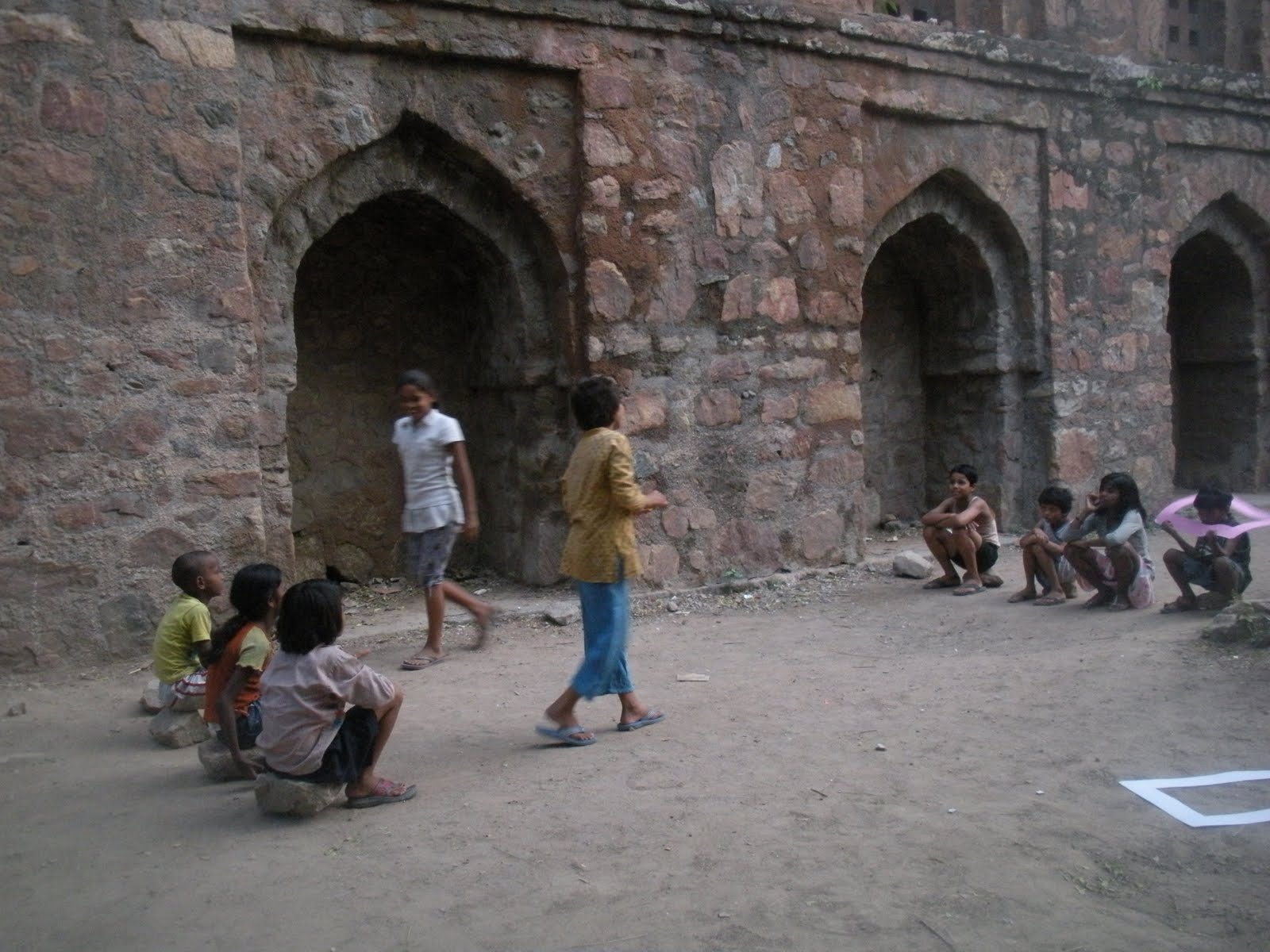
What about children? Parents fear traffic and strangers in streets. Parents permit play in parks especially if other children from the neighborhood are also present. Children also cite the presence of other children as a major reason for wanting to play in parks. In middle class planned neighborhoods across Delhi, children are not visible at all in the streets. The few children who play in these streets come from nearby slums. However in places like Khirkee and Nizamuddin Basti children actually play in the streets, squares and any open space near home more than they play in the planned parks they claim as their favorite places. Parks maybe the dream, but play really unfolds in the spaces near home and in particular the shaded narrow streets for majority of children living in Khirkee. This kind of play is the best form of social participation of children in community life. Because we do not know much about it, it is safe to say whether as a social worker, or planner or designer that parks are the best play spaces for children. If we really care for children we should start seeing how play really unfolds in urban space and provide for it across the entire public realm of our cities and not just in parks and playgrounds.
 Streets near home always a much used play zone within settlements with pedestrian cores