Wednesday, June 1, 2011

An unscheduled trip to the Quila and never before played games in a zone of cricket


After getting a tour of their immediate neighborhood, we asked the children most of whom lived in Panchsheel Vihar and played at the DDA park if any of them ever used the ‘Quila’ and its compound for play. Most of the children (even the boys) said that they aren’t allowed to go there by their parents because it is considered unsafe. Two of them, however, Radha and Sultana, said that they like to go there. Interestingly, both of these 9 year old girls had short hair, and dressed and behaved like boys. Both were extremely active, always dressed in shorts and constantly running or climbing things. We asked them to show us where in the ‘Quila’ they play. The daredevils entered the compound (which had many older adolescent boys in it) without batting an eyelid, while the rest of the group hesitated just outside. Their preferred place was on one side away from the where the older boys stood. It contained a large pile of rocks, some overgrown grass on the side with bits of rubbish lying around.


Gol-Chakkar

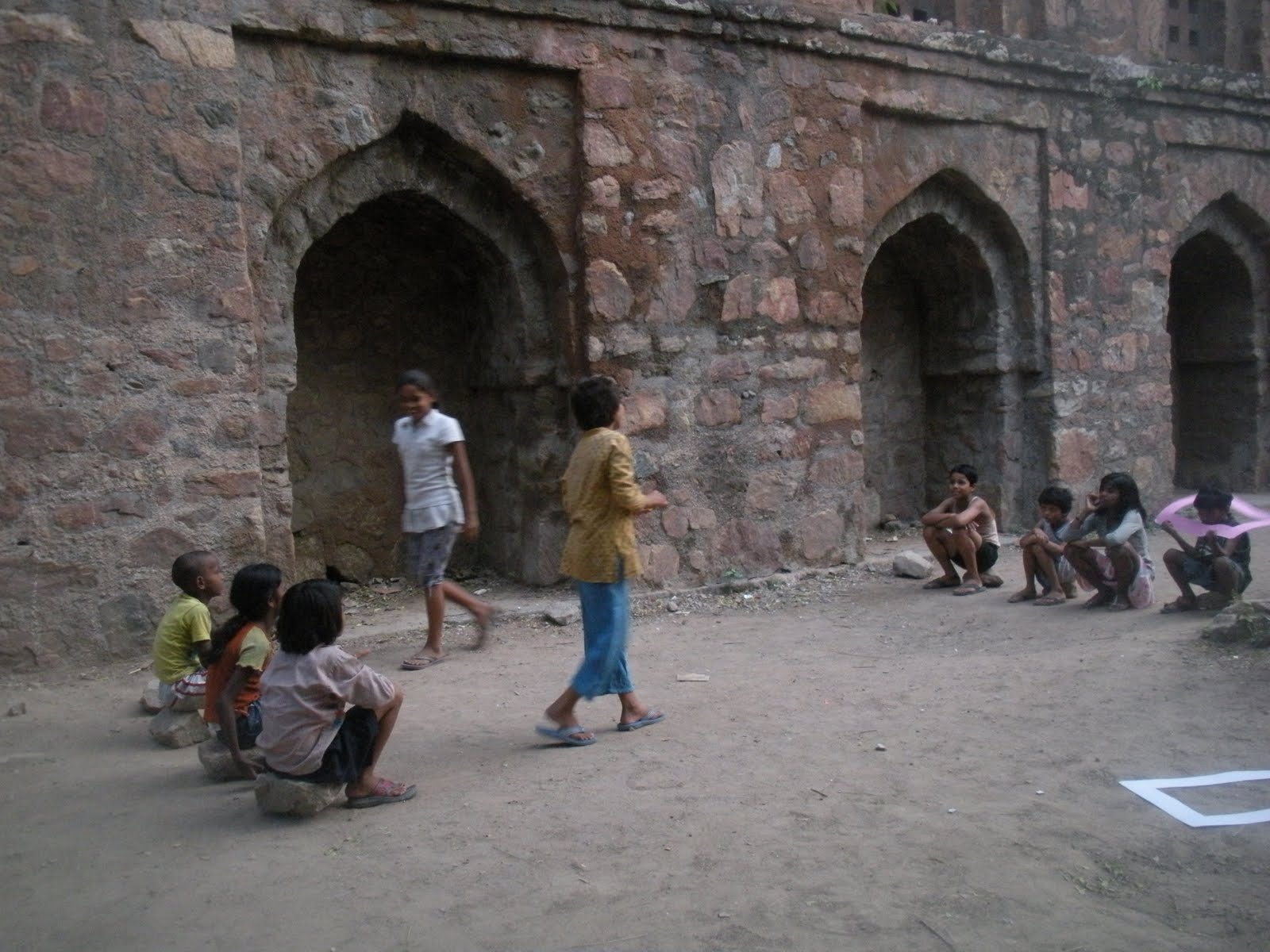
We asked the children to play any of their favorite games. Within 10 seconds, they were all busy heaving huge rocks to a clearing, and arranging them in the circle. We were amazed at how quickly and spontaneously they had assessed their environment and made use of it to make a variation of a game they played. When they had arranged the stones, they stood on top of them, held hands and skipped from one stone to the next. Whoever stepped on the ground was ‘out’ and the last one standing was the winner. They called this game “Gol Chakkar” or “Roundabout”.


Son-Pari

When this game got over, they shifted to another one which they called ‘Son-Pari’. Rinki and Gudiya became leaders of opposing teams and then they rearranged the same stones into two lines, some distance apart. The team members sat on them facing each other. This game was particularly fascinating, as it seemed like a complex mixture of chess and ‘guess-who’; utilizing team-work, long-jump skills, and verbal creativity. The leader would close the eyes of one member of the other team and using creative variations of the ‘son-pari’ rhyme, call on one of her team members to touch the blindfolded member. If the person who was blindfolded guessed the name of the persona who touched her/him right, then she could make a one step jump and move closer to the other team.

A couple of children who did come to play here before had only played cricket, the sacred sport of this zone. On receiving encouragement from two friendly adults who watched over them and ensured they could not be chased away from this space by older boys and who cheered them as they played traditional games which were mostly played on the terraces and streets of Panchsheel Vihar, the children allowed themselves to create new games and engaged in free play in a space that has never before afforded that. This experience, for me, underlines the importance of play stewards in contested community open spaces in promoting free play and nurturing creativity in children.

Imagination at play on the sidelines of team game


As we watched the DDA group play "Son Pari" in the open space behind the main staircase of the Masjid, we suddenly realized that Radha wasn’t part of this play group. When we looked around we found that she was absorbed in a kind of play of her own in a corner. She had noticed a tiny plant (probably a weed) growing away from the general grass and had proceeded to find things in her environment to construct something around this plant. She had gathered small pebbles, and was plucking twigs from an abandoned broom to make a sort of border around the plant, completely oblivious to the others playing the group game.

I had bumped into Radha several times near the "Quila" and always thought she was a boy because of the short hair and the shorts and T-shirt attire. Only that evening when the kids selected by Rinki for the child-led fieldtrip was introduced to us, I realized that she was a girl. I wondered if her boyish appearance was a camouflage to gain access to most spaces in the village including the Quila which has a negative reputation and known to be a boyz zone.

At another instance, Gudiya while wandering through the compound had picked a long stick and was attempting some sort of a pole vault with it. It was really delightful to see the creativity of these children, especially when they were unaware of being observed.

DDA kids show their favorite play spaces

The Frames arrive for the first field trip to DDA Park.

What is it for? Oh we know, this is for playing TV. The ones behind it will have to act and the ones in front shoot.

Yeah, that's very good. Let's see you play TV.

Or maybe you can also take pictures of your best friend's play spaces and favourite things in that space

The DDA Park is Rinki's favorite play space because it has lots of children to play with. Her best friend Aradhana took this picture while Rinki framed it.

"I also like it because of the pretty flowers over the gate", Rinki.

Sahil likes the park because it has places to hide during hide and seek.

Parked cars in the gully are good for hiding too!


Sunday, May 22, 2011

Knowledge Live brings world playground news to my screen

Knowledge Live is proving to be a pandoras box. Ever since I started blogging about play and play environments, and with Charu introducing keywords such as “children” and “playgrounds” in the feed aggregator, a wealth of news, promotions, advertisements, perspectives, and even some personal accounts have started popping up. Most of these pieces are about playgrounds including one that visually documents a creepy children’s playground in Russia where pictures of surreal art objects in playgrounds are inserted in a page containing borderline pornographic material. I decided to explore the contents of this diverse range of materials to see what interesting themes are being thrown up and possibly explore them further through Play@Khirkee.

Playground as a social experience for mothers

This morning a mother of an autistic child blogged about her encounter with another mother in a nearly empty playground on a rainy day. Complete strangers to each other, these women chatted as they watched their young children play. Both discovered that each had a special needs child other than the ones accompanying them that day. One of them chose to give up her Downs syndrome child to be brought up by another family. Even as she opened up to a sympathetic stranger in a park, she cried behind her large sunglasses. As the two women walked away with their children and with a tacit agreement to meet again, our blogger/ listener realized that they had not even exchanged names. However she was moved enough by this experience to blog about it in the morning. What strikes me about this post is the socializing potential of the playground not just for children but also for mothers and caregivers, the potential to meet strangers with unknown histories, share stories and make connections which perhaps allow us to evaluate ourselves from a new perspective. I had no intention to look at playgrounds from this perspective before I read this blog. I now want to explore this important aspect of the nature of social experience of caregivers in playgrounds.

Playgrounds through collaborations between community, non-profits and business

Skimming through many news items related to playground equipments (some of which are quite unintelligible) I chanced upon an interesting news item:

“Children in New Brunswick received a brand new playground today thanks to the effort of more than 400 volunteers from ForestersTM, a life insurance provider committed to the well-being of families, Greater Brunswick Charter School and non-profit KaBOOM!. The new playground will serve 4,500 children and their families in the local community for years to come. Planning for the playground began at a Design Day event held in March when local children and community leaders met with organizers from KaBOOM! and Foresters to design their dream playground. The children’s drawings were then used to create the final playground design.” (http://insurance.gnom.es/news/foresters-kaboom-volunteers-encourage-quality-family-time-by-building-new-playground-for-new-brunswick-children)

The playground is seen as a vital community resource and promoted as such by a non-profit who facilitated the convergence of community and business interests to create a playground designed by children. Wouldn’t that be a wonderful example to follow in a place like Khirkee.

Children’s gardens and nature playgrounds within regional parks

Yesterday, a children’s garden and a natural playground opened inside the large Assiniboine regional park in Winnipeg. This 283 acre park is the first regional park in Winnipeg and was created in 1904.

The park website promotes the new children’s facility as:

“Exercise your imagination while you explore the sand and water play area, a sky-high crow’s nest, willow tree tunnels, basket swings, mazes, net bridges, and topiaries. These unique features are inspired by and incorporated into the area’s natural surroundings, which include two acres of trees, gently rolling hills, playful streams, and mountains to climb....In winter, snow and ice will transform the Children’s Garden and Nature Playground into a frosty wonderland with snow forts, toboggan runs, ice sculptures and outdoor fire pits.”

The practice of introducing children’s facilities in the form of gardens and nature themed playgrounds is common in the USA. I have visited two such children’s gardens, both inside existing botanical gardens, one in Atlanta and another in Chapel Hill. This illustration of introducing children’s gardens in regional parks maybe a good example for a city like Delhi, which at 19% green cover has the largest green cover of all large cities in India. Delhi has over 15000 parks and gardens of which about 14000 are maintained by MCD, 1100 by NDMC. DDA has 4 regional parks, 111 district parks and 225 neighborhood parks. 80% of Delhi’s schools have playgrounds. Yet Delhi has hardly any well designed environment for children and definitely no nature-based children’s facilities.

Children’s playground as a protective shield for dictator

The Telegraph reported on May 14, 2011:

"Even for an Arab dictator, it is an unusually cynical variant of the "human shield" gambit. On the roof of his Tripoli command bunker, Colonel Gaddafi has installed a children's fairground. Forty feet away from the crater made on Thursday by a NATO bomb, young boys and girls played happily on a roundabout shaped like a giant tea set."

Using a playground as a protective human shield is perhaps the most evil use of a children’s facility. However around the world open spaces, parks and playgrounds are used regularly as visual shields to cut off unsightly areas such as slums. And most often than not, the slum kids are prevented from playing in these parks especially if the city has invested in landscaping these facilities.

Saturday, May 14, 2011

Week 1: Parks and Open Spaces


We have found, much to our surprise, a number of parks and open spaces within the tight built fabric of Khirkee village. There’s Nandan Park which is close to the pink temple on the main spine of the village leading to Malviya Nagar. MCD has only recently reclaimed this park for public use from the custody of some of the original settling families who virtually used this park as their private space. There’s the long and narrow Prithviraj Chauhan Park and a smaller rectangular park across from it on the southern side. There are two other parks abutting the Khirkee DDA flats to the north side of Prithviraj Chauhan Park. Each of these spaces has their own politics and dynamics as well as strong environmental and perceptual cues for children.

Prithviraj Chauhan Park: layout and observed uses and behaviors

On our many trips to Prithviraj Chauhan Park, I noticed different age groups, boys and girls, mothers, other adults using the place at the same time. This park is clearly demarcated in three zones that to my mind serve as multiple activity nodes for different user groups.

Zone 1 comprises a dusty barren space with a few trees in the periphery. A street-facing temple carves out some space from the north east corner of this zone which at its eastern narrow end is about 25 meters wide. The first zone is where the older boys play cricket and football, with occasional cycling activities by younger children.

Zone 2 comprises a well-kept middle area with a grass lawn, a dry fenced off fountain lined with tiles. Trees and flowering bushes and hedges make this one of the prettiest places inside the village. At its widest Zone 2 is about 40 meters wide. The middle zone is the zone for women, girls of all ages and sizes and younger boys. Children engage in a variety of games under the watchful eyes of mothers, aunts, neighbours and other adults.

The space in between the first and second zones serves as a waiting area with several benches facing zone 1. This is also the space where people enter the park and has the option of going left to zone 1 or right to zone 2. Women, younger children and elderly were seen using the benches when we visited. One time we saw adolescent girls playing badminton in this linear space. There are several markers that help to define these zones: a massive tree with a raised fenced off base housing a sacred space holds eastern end of zone 1 before the transition zone, the entry into zone 2 from the transition zone are further articulated through framing the entries into the two walkways along the long sides of the park by trees and hedges.

Zone 3 is separated from zone 2 by a hedge, a walkway that merges with the dirt of this zone though walkers still complete their rounds ignoring the lack of the physical walkway. Even though a row of houses squeeze down this end of the park, the houses are separated by a pedestrian street from the park’s boundary wall. A raised cemented portion in front of the pump house has a bench where assorted people including men and adolescents boys hang out. Sometimes we saw smaller girls playing in this cemented area. Khoj once did a toy-making workshop here where children baked clay toys. Next to this cemented area is a unkempt overgrown patch where we saw older boys playing cricket.

DDA Parks

The park across from the popular Prithviraj Chauhan Park on the north is a L-shaped dusty ground which was used by two groups of boys for sports on both days we visited. The park had not been marked on the Khirkee map drawn up by DDA and posted on major intersections inside the village. The rectangular dusty ground in front of the DDA buildings (which also hasn’t been marked on the map) was another interesting space to observe. The groups of children playing here were very different from the ones in the grassy park. The entrance of the park seems to be under construction and was piled high with logs, sand and gravel. About two-thirds of the park was used by older adolescent boys. The other part was used by a group of children mainly from the Panchsheel Vihar area behind the DDA flats. Most of them lived in the rag pickers’ colony. Some of them had attended KHOJ workshops earlier and were keen that we do a theatre or dance workshop with them. In one corner of the park under a tree, we saw that they (girls) had made an ingenious temporary see-saw by balancing two logs of wood (from the pile of construction material) on the back edge of a movable bench placed between two trees. It was quite a sight to see 4-5 children enjoying themselves with this simple yet creative invention.

The park where no children played

There is a smaller rectangular park across the road on the south from Prithviraj Chauhan Park. This park is cosily tucked in from the road and surrounded by residential buildings that overlook it. There is only a narrow pedestrian street between the park and the buildings. This park has two entrances: one from the middle of the inner long side near the buildings and another from an outer corner facing the main street. Both entrances appeared as if they were made as an afterthought by breaking the thick masonry wall. The boundary wall is quite high, about four and a half feet and on top that there is an additional iron grille about one and a half feet tall. Inside were two large trees located in the two halves of the rectangle. In addition there were another 9 trees of different kinds along the southern and western and to some extent the north western edge. The western quadrant of the park has a grass lawn with four benches around it. The eastern quadrant is a dirt top with a heap of mulch, leaves and debris at the foot of the majestic tree that shades this zone. We never saw any children playing here. And I wonder why. This little park, cosily nested within the residential fabric of the neighborhood, to my mind presents an opportunity to meet neighbors, friends, while younger children played in the lawn. For girls also this space physically affords a protected yet central space for hanging outdoors with friends and playing without fear of a cricket ball hitting them or boys shooing them away. We want to probe this to find out why this little park lies unused while all the other parks around it bustle with people and activities.